
The Birth of Printing and Early Periodicals: From Gutenberg to the Public Sphere
Human history is shaped by revolutions in how knowledge is preserved and multiplied. Johannes Gutenberg's invention of movable metal type in the 1440s shattered the centuries-old monopoly of knowledge guarded behind monastery walls and royal archives. This printing revolution, which began with folios and books, evolved by the 17th century into periodicals circulating through coffeehouses and intellectual salons. In this lesson, we explore how modern periodical publishing was born and trace the fascinating etymology of the word 'magazine.'
What You Will Learn in This Lesson
- Grasp the technological and societal impacts of Gutenberg's press that set the stage for periodic publishing
- Trace milestone publications: Johann Rist's 1663 Erbauliche Monaths Unterredungen, 1665 Journal des Sçavans, and 1731 The Gentleman's Magazine
- Explore how the Arabic root 'makhzan' (storehouse/treasury) evolved into the universal publishing term 'magazine'
- Examine the 24 founding periodicals across East and West that established global publishing typologies prior to 1900
The Gutenberg Revolution and the Democratization of Knowledge
Before the printing press, hand-copying a single manuscript demanded months or years from scribes and monks; a single book was worth a small fortune. Gutenberg's technique of casting movable metal letters reduced production time and costs by a hundredfold.
Literacy surged across cities, ideas crossed borders with unprecedented speed, and citizens began seeking regular, periodic sheets through which they could analyze secular events, trade currents, and scientific observations.
The World's Earliest Periodicals and the Genesis of the Term 'Magazine'
In press history, the world's earliest regular periodical is recognized as 'Erbauliche Monaths Unterredungen' (Edifying Monthly Conversations), published in Hamburg in 1663 by theologian and poet Johann Rist. It presented literary dialogues and essays on an uninterrupted monthly calendar.
Shortly thereafter, in 1665, Paris saw the debut of 'Journal des Sçavans' as the first academic bulletin, while London's 'Philosophical Transactions' became the first peer-reviewed scientific journal in the same year. In 1672, Jean Donneau de Visé launched 'Mercure Galant' in France, pioneering the cultural blend of literature, arts, fashion, and society news.
The Arabic Root 'Makhzan' and Periodicals in the Eastern World
In 1731, Edward Cave transformed publishing terminology forever when he launched 'The Gentleman's Magazine' in London. Cave adopted the word 'magazine' from the Arabic root 'makhzan' (مخزن), meaning treasury, repository, or granary. To Cave, a periodical was precisely that: an intellectual granary gathering poetry, essays, and critical thought under one roof.
Similarly, rich traditions of collective periodic anthologies flourished in the Islamic and Eastern worlds. From the 15th century onward, manuscript 'Mecmua' and 'Cönk' collections curated poetry and philosophy across Istanbul, Bursa, and Samarkand. In the 19th century, vibrant Arabic periodicals arose in Beirut and Cairo: Halil el-Huri's 1858 'Hadiqat al-Akhbar', Butrus al-Bustani's 1870 'Al-Jinan' (الجنّان)—a cradle of modern Arabic prose—the 1876 popular science pioneer 'Al-Muqtataf' (المقتطف), and Jurji Zaydan's 1892 Cairo review 'Al-Hilal' (الهلال), which remains in publication after more than 130 years.
Coffeehouses and the Public Sphere: The Sociology of the Periodical
In 18th-century Europe, periodicals were not printed for silent cloistered study; they were read aloud and debated passionately in the coffeehouses of London and Paris. What sociologist Jürgen Habermas defined as the 'Public Sphere'—a space for rational, critical citizen debate—was born in these pages.
Any citizen could read a periodical essay and freely critique government policy, royal decrees, or the latest theatrical production. Periodical publishing became the foundational cradle of modern civic discourse and critical thought.
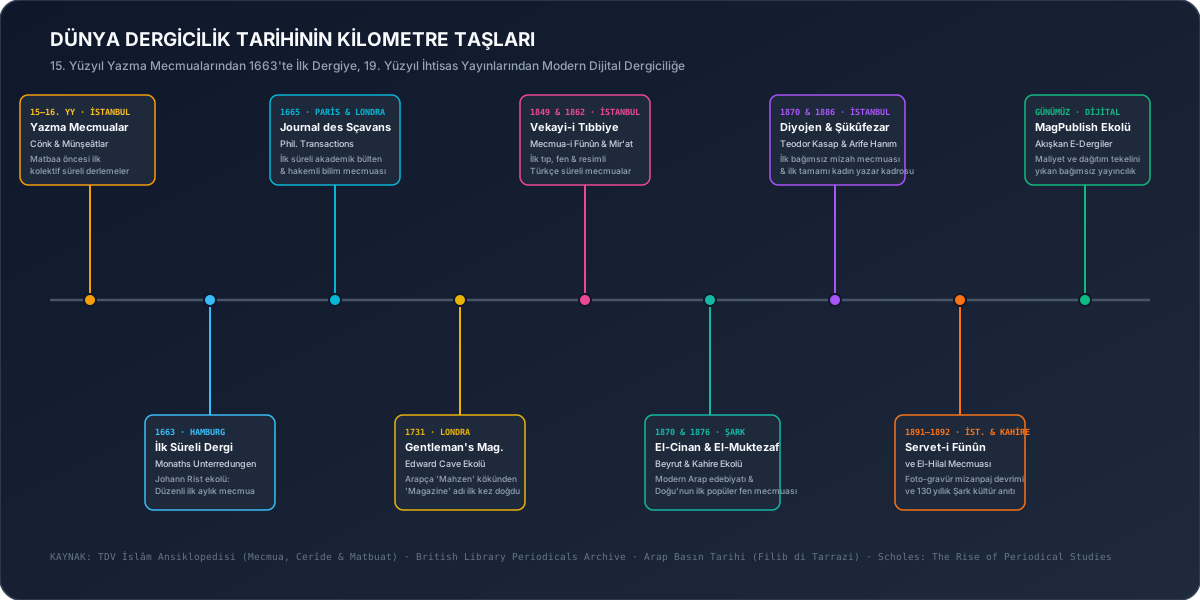
Founding Periodicals Matrix (Pre-1900)
A comprehensive chronological matrix of the pioneering periodicals that established publishing archetypes and specialized genres across the globe prior to 1900:
| Periodical Name | Founded | City / Geography | Specialty & Genre | Historical Significance |
|---|---|---|---|---|
| Manuscript Poetry & Thought Anthologies | 15–16th C. | Istanbul, Bursa & Samarkand | Literature, Philosophy & Culture | Earliest hand-curated thematic anthologies compiling multiple authors prior to movable print |
| Erbauliche Monaths Unterredungen | 1663 | Hamburg · Germany | Philosophy & Literary Dialogues | Johann Rist school: The earliest regular periodical published on a continuous cadence |
| Journal des Sçavans | 1665 | Paris · France | Science, Experiments & Philosophy | World's first academic research and scientific review bulletin |
| Philosophical Transactions | 1665 | London · England | Natural Sciences & Medicine | Royal Society: World's first peer-reviewed scientific periodical |
| Mercure Galant | 1672 | Paris · France | Literature, Fashion & Society | First popular culture, arts, and lifestyle magazine format |
| The Gentleman's Magazine | 1731 | London · England | Culture, Politics & Essays | First to adopt 'Magazine' (from Arabic makhzan / thought granary) as a title |
| The Lancet | 1823 | London · England | Medicine & Clinical Surgery | World's oldest independent peer-reviewed medical journal, publishing for over two centuries |
| Scientific American | 1845 | New York · USA | Science, Inventions & Industry | Oldest continuously published popular science review in the world |
| Vekayi-i Tıbbiye | 1849 | Istanbul · Ottoman | Medicine, Hygiene & Surgery | Imperial Medical Society: First regular medical periodical in the Ottoman and Islamic worlds |
| Hadiqat al-Akhbar | 1858 | Beirut · Lebanon | Literature, Poetry & Commerce | Khalil al-Khouri: First independent Arabic periodical featuring literary essays and cultural commentary |
| Mecmua-i Fünûn | 1862 | Istanbul · Ottoman | Sciences, Education & Philosophy | Münif Pasha & Ottoman Scientific Society: First Turkish general scientific review |
| Mir'at (The Mirror) | 1862 | Istanbul · Ottoman | Culture, Biography & Arts | Pioneer of visual illustrated journalism using lithographic portraits and fine engravings |
| Mecmua-i Askeriye | 1864 | Istanbul · Ottoman | Military Strategy & Cartography | Ottoman General Staff: First professional military strategy and cartography review |
| Nature | 1869 | London · England | Fundamental Sciences & Biology | Landmark weekly journal that first announced X-rays, the structure of DNA, and plate tectonics |
| Terakki-i Muhadderat | 1869 | Istanbul · Ottoman | Women's Education & Family | First regular women's periodical supplement advocating education and civic equality |
| Mümeyyiz | 1869 | Istanbul · Ottoman | Child Pedagogy & Morals | Sıtkı Efendi: First specialized children's periodical, printed on distinct colored papers |
| Diyojen | 1870 | Istanbul · Ottoman | Political Satire & Humor | Teodor Kasap: First satirical review, bearing the motto 'Out of my sun; I ask nothing else' |
| Al-Jinan (الجنّان) | 1870 | Beirut · Lebanon | Literature, Culture & History | Butrus al-Bustani: Founding pillar of modern Arabic periodical prose and enlightened civic education |
| Al-Muqtataf (المقتطف) | 1876 | Beirut & Cairo | Popular Science & Innovation | Yaqub Sarruf & Faris Nimr: Regarded as the Scientific American of the Arabic-speaking world |
| Şükûfezar (Flower Garden) | 1886 | Istanbul · Ottoman | Women's Movement & Literature | Arife Hanım: First periodical managed and written entirely by a staff of women |
| Servet-i Fünûn | 1891 | Istanbul · Ottoman | Modern Literature & Photo-Gravure | Ahmet İhsan & Tevfik Fikret: Groundbreaking layout revolution that elevated a periodical into a literary school |
| Al-Hilal (الهلال) | 1892 | Cairo · Egypt | History, Literature & Thought | Jurji Zaydan: Prestigious intellectual and cultural monthly publishing continuously for over 130 years |
| Vogue | 1892 | New York · USA | Fashion & Visual Aesthetics | Established global standards for haute editorial layout, typographic grace, and art direction |
| Billboard | 1894 | Cincinnati · USA | Entertainment & Poster Advertising | Pioneer of dedicated B2B trade publishing and entertainment industry monitoring |
| Hanımlara Mahsus Gazete | 1895 | Istanbul · Ottoman | Sociology, Women & Philosophy | Fatma Aliye Hanım & Poet Nigâr: The most enduring weekly women's intellectual journal in the East |
Expert Perspectives & Foundational Sources
Ebüzziyâ Mehmed Tevfik's launch of specialized periodicals for targeted readerships serves as an early pioneer of audience segmentation. He seamlessly harmonized editorial curation with tactile printing craft.
Key takeaway for this lesson: An editorial concept, reader persona, narrative format, and technical print production must always be architected as an indivisible whole.
Şinasi's publishing model for Tasvîr-i Efkâr framed periodicals as vital public forums that mirror civic thought. His deliberate pursuit of plain syntax and accessible editorial design proved that publication identity is defined as much by tone and typography as by subject matter.
Key takeaway for this lesson: For modern magazines, this demands a razor-sharp editorial mission, crystal-clear language, and an unpretentious, disciplined page layout supporting that purpose.
Practical Application & Field Case
The Gentleman's Magazine'in 1731'deki ilk sayısı, sadece İngiltere'de değil tüm sömürgelerde ve Avrupa'da kapış kapış satılmış; dergiciliğin kitleleri harekete geçiren devasa bir kültürel güç olduğunu kanıtlamıştır.
Note: Examples not explicitly cited are educational scenario models designed to illustrate editorial methodology; names and metrics are illustrative.
Critical Editorial Warnings & Common Pitfalls
- Dergiyi sadece kuru bir tarih kronolojisi olarak görmeyin; onun arkasındaki özgür düşünce ve kamusal tartışma ruhunu kavrayın.
- Bilimsel veya fikri alıntılarda ilk kaynaklara inmeden kulaktan dolma tarihi bilgilerle içerik üretmeyin.
- Yayıncılığın teknolojik araçlardan ibaret olmadığını, asıl gücünü düşünce hürriyetinden aldığını unutmayın.
Lesson Summary & Core Takeaways
- Gutenberg's movable type shattered knowledge monopolies and laid the technical foundation for periodic media.
- Johann Rist's 1663 review, the 1665 Journal des Sçavans, and 1731 The Gentleman's Magazine are foundational world landmarks.
- 'Magazine' is an Arabic loanword meaning 'makhzan' (thought granary), unifying Eastern and Western traditions.
Finished this lesson?
You can proceed directly to the next lesson. Reading bookmarks, resume reading, quizzes, module exams, and verified certificates are unlocked for students accepted to our 100% free Education Program.